Sunday, October 24, 2021

Cook, Eleanor Emily - Southampton, MA

Cook, Eleanor Emily

Southampton, MA

N 42° 14.078 W 072° 43.649


The grave of Eleanor Emily Cook is marked by a marble horizontal marker in a family plot in the historic Center Cemetery in Southampton, MA. The marker is inscribed:

                                                    ELEANOR EMILY COOK
                                                 MARCH 17, 1936
                                                    JULY 6, 1944

On July 6, 1944, in Hartford CT, the Ringling Brothers Barnum and Bailey Circus tent caught fire. The inferno killed 167 people and injured 700 more. The most famous casualty of the fire was an unidentified 8 year old girl known only as "Little Miss" 1565, the number assigned to the body by the coroner.

She was buried with five other unknown victims in Northwood Cemetery in Windsor, CT and despite nationwide and worldwide media coverage, he body was never claimed. Forty-seven years later she was identified by the Connecticut State Police forensics unit as Eleanor Emily Cook of Southampton, MA. Her body was exhumed and placed in a family plot next to her brother Edward, who also died in the Hartford Circus Fire, in Center Cemetery in Southampton, MA.


Her cenotaph in Northwood Cemetery in Windsor, CT  (N 41° 48.577 W 072° 39.973) is inscribed:

                                        RESTED IN PEACE HERE 47 YEARS AS
                                                 "LITTLE MISS"
                                                                    1565


Cooper, James Fenimore - Cooperstown, NY

Image result for james fenimore cooper"
James Fenimore Cooper
Cooperstown, NY
N 42° 41.895 W 074° 55.342

The grave of James Fenimore Cooper is located in Christ Church graveyard at Church and Fair Streets in Cooperstown, NY. It is marked by a 7' by 3' rectangular stone slab supported a few inches off the ground, often called a false tomb, next to his wife Susan Augusta, in the graveyard of Christ Church in Cooperstown, NY. The stone covering his grave has a raised cross and the incised inscription:

JAMES FENIMORE COOPER
BORN SEP 15 1789
DIED SEP 14 1851

Inscription
James Fenimore Cooper was born on September 15, 1789 in Burlington, New Jersey. His family moved to what became Cooperstown, NY when he was one year old and he lived there the remainder of his life. He inherited wealth and married Susan Augusta De Lancey. He was looking for a way to occupy himself when his wife challenged him to write a book. The result was The Spy: A Tale of Neutral Ground published in 1821.

In 1923 he wrote The Pioneers which evolved into his most famous work, a five book series with the main character being Natty Bumppo, called The Leatherstocking Tales. which included The American Democrat (1838), The Last of the Mohicans (1826), The Pathfinder (1840), and The Deerslayer (1841). He then turn his efforts to to naval history and wrote The History of the Navy of the United States of America (1839), The Cruise of Sommers (1844), and The Distinguished American Naval Officers (1846) which contained the biographies of Commodores William Bainbridge, Richard Somers, John Shaw, William Shubrick and Edward Preble.

In 2013, James Fenimore Cooper was inducted into the New York Writers Hall of Fame.

Setting

Saturday, October 23, 2021

Davis, Miles - Bronx, NY

Miles Davis
Woodlawn Cemetery
Bronx, NY

N 40° 53.099 W 073° 52.311
In Memory Of
Sir Miles Davis
1926 ~ 1991

American trumpeter, bandleader, and composer. One of the most influential figures in the history of jazz.

Awards and Honors

1955 Voted Best Trumpeter, DownBeat Readers' Poll
1957 Voted Best Trumpeter, DownBeat Readers' Poll
1961 Voted Best Trumpeter, DownBeat Readers' Poll
1984 Sonning Award for Lifetime Achievement in Music
1986 Doctor of Music, honoris causa, New England Conservatory
1988 Knighthood by the Knights of Malta
1989 Governor's Award from the New York State Council on the Arts
1990 St. Louis Walk of Fame
1991 Australian Film Institute Awrd for Best Original Music Score for Dingo, shared with Michel Legrand
1991 Knight of the Legion of Honor
1998 Hollywood Walk of Fame
2006 Rock and Roll Hall of Fame
2006 Hollywood's Rockwalk
2008 Quadruple platinum certification for album Kind of Blue
2019 Quintuple platinum certification for album Kind of Blue

de' Medici, Lorenzo Duke of Urbino - Florence, Italy

Duke of Urbino
Florence, Italy
N 43° 46.516 E 011° 15.200


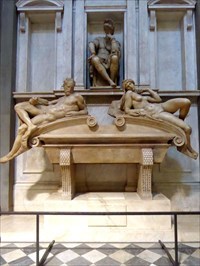
The tomb of Lorenzo de' Medici Duke of Urbino is located in the New Sacristy of the Medici Chapel at Piazza di Madonna degli Aldobrandini, 6, Florence, Italy. The tomb  is one of Michelangelo's most famous creations. The sculpted tomb was created in the New Sacristy of the Medici Chapel that was designed by Michelangelo. The tomb contains a marble sarcophagus and three sculpted figures.

A above the sarcophagus is a seated sculpture of Lorenzo de' Medici Duke of Urbino. He is wearing a Roman suit of armor with a helmet placed forward over his forehead. His head right hand is resting on his right thigh and his left hand is touching his left cheek. The sarcophagus is flanked by two of Michelangelo's most famous sculptures: the reclining nude male figure representing dusk on the left and the reclining female figure called Aurora representing dawn.

Dusk - Sarcophagus - Dawn 
A sign next to the tomb is inscribed:

TOMB OF LORENZO, DUKE OF URBINO

Michelangelo sculpted tomb of Duke of Urbino
(1492-1519) nephew of Leo X, during his last years in Florence
between 1531 and 1532. Dedicate of Machiavelli's The Prince,
Lorenzo is portrayed immersed in thought, and his pensive
temperament is in line with the allegories of time placed at
either side of the sarcophagus. Dawn seems to be waking from
the torpor of sleep, while Dusk, in abandon of painful
inertia, seems to be about to fall asleep


Lorenzo was born in Florence on September 12, 1492. He was the a son of Piero di Lorenzo de' Medici and Alfonsina Orsini and the grandson and namesake of Lorenzo "The Magnificent" de' Medici. When his uncle, Giuliano de' Medici, handed over control of its government, in August 1513, he became the leader of the Republic of Florence. The position did not suit him well and in 1516 he had his uncle, Pope Leo X, make him Duke of Urbino at age 24.

As a general in the army of the Republic of Florence, he lead their troops during War of Urbino (1517) against the former Duke of Urbino, Francesco Maria I della Rovere. During the war he was wounded and retired to Tuscany. In September 1517, he regained Urbino by a treaty. In 1521, the Urbino reverted to the Della Rovere family.

de' Medici, Lorenzo "The Magnificent" - Florence, Italy

Lorenzo "The Magnificent" de Medici
Medici Chapel
Florence, Italy

N 43° 46.516 E 011° 15.200


The sepulcher holding the remains of Lorenzo "The Magnificent" de Medici is located in the new sacristy of the Medici Chapel. Is an altar-like structure with the sculptures of Saint Cosmas by Giovan Angelo de Montorsoli on the left, the Madonna and Child by Michelangelo in the center, and Saint Damian by Raffaello da Montelupo on the right. The sculptures were added by Giorgio Vasari in 1554.

Medici Chapel
The sepulcher also contains the remains of Lorenzo's brother Guiliano de Medici who was killed in the Pazzi conspiracy attack on Medici family on Easter Morning, April 26, 1478. Lorenzo was wounded but survived the attack.

The front of the sepulcher is inscribed:

LORENZO IL MAGNIFICO & GUILIANO DEI

Lorenzo de Medici was He was born in the Republic of Florence on January 1, 1449. He was a Florentine statesman and the de facto ruler of the Florentine Republic from the age of twenty, when his father, Piero di Cosimo de Medici, died until his death on April 8, 1492 at age 49.

Lorenzo "The Magnificent" de Medici is famous for being the foremost patron of the Renaissance culture in Italy. Among the artist receiving patronage from Lorenzo were Leonardo da Vinci, Michelangelo, Sandro Botticelli, and Domenico Ghirlandaio. Lorenzo himself was an artist and wrote poetry. Lorenzo also expanded the Medici Library begun by his grandfather Cosimo. He employed a great number of workers to copy books and spread them across Europe.

Dickinson, Emily - Amherst, MA

Emily Dickinson
Amherst, MA
N 42° 22.746 W 072° 31.074


The grave of Emily Dickinson, the Belle of Amherst and  arguably the most famous American female poet,  is located in West Cemetery, Triangle St., Amherst, MA .

Amherst, MA was the home of Emily Dickinson, the Belle of Amherst; arguably the most famous American female poet. She is world renowned for her brief, insightful poetry. The house she
rarely left and her grave-site are only a few hundred meters apart. She lived at her family home at 280 Main St. in Amherst and is buried in West  Cemetery in Amherst, MA.

The rectangular marble headstone is located in a fenced in family plot. The headstone is inscribed:

EMILY DICKINSON
BORN
DEC. 10, 1830
CALLED BACK
MAY 15, 1886
A bronze plaque in the fence is inscribed:

IN MEMORIUM 
EMILY DICKINSON
POETESS
ERECTED BY
THE DICKINSON KINFOLK
AUGUST 28, 1951


Here is her most appropriate poem - a classic example of her wisdom and style.

"Because I could not stop for Death,
He kindly stopped for me;
The carriage held but just ourselves
And Immortality.
We slowly drove, he knew no haste,
And I had put away
My labor, and my leisure too,
For his civility.

We passed the school, where children strove
At recess, in the ring;
We passed the fields of gazing grain,
We passed the setting sun.

Or rather, he passed us;
The dews grew quivering and chill,
For only gossamer my gown,
My tippet only tulle.

We paused before a house that seemed
A swelling of the ground;
The roof was scarcely visible,
The cornice but a mound.

Since then 'tis centuries, and yet each
Feels shorter than the day
I first surmised the horses' heads
Were toward eternity."

World Renowned American Poet, she was born in Amherst, MA and raised in a puritanical tradition, beliefs she would later challenge. Reclusive and shy, she never married but dedicated her life to writing poetry. Only seven of her poems were ever published in her lifetime. After she died, it was discovered that she had written a total of 1,775 poems arranged into four themes: Friends, Nature, Love, and Death. Many of her poems were published posthumously.

Diggs, Deborah Sugarbaker - Amherst, MA


Deborah Sugarbaker Diggs
Wildwood Cemetery
Amherst, MA
N 41° 53.501 W 072° 30.675


The grave of Deborah Sugarbaker Digges and her third husband Franklin Martin Loew is marked by a beautiful bronze sculpture of a running horse set on a bronze plinth over a rectangular polished black granite base. The front of the base is inscribed:

FRANKLIN MARTIN LOEW SEPT. 5, 1939 - APRIL 22, 2003

DEBORAH SUGARBAKER DIGGES FEB. 6, 1950 - APRIL 10, 2009

The top of the base is inscribed: WE'LL MEET AGAIN.

Deborah Leah Sugarbaker was born Deborah in Jefferson City, MO on February 6, 1950. She studied art at the University of Missouri and earned a BA degree in English at the University of California, Riverside, in 1975, and a Master of Fine Art degree from the Iowa Writers' Workshop. She took the last name of her first husband, an Air Force pilot, with whom she had two children. She was predeceased by her third husband Franklin Martin Loew, who was a Dean at Tufts University where she was a professor.

Deborah Sugarbaker Digges wrote lyrically and hauntingly about the challenges of everyday life. Collections of her poetry include: Digges’s collections of poetry include Vesper Sparrows (1986), which won the Delmore Schwartz Memorial Prize for a best first book of poetry; Late in the Millenium (1989); Rough Music (1995), Trapeze (2004), The Wind Blows through the Doors of my Heart (2010). She also wrote two books of memoirs: Fugitive Spring (1992), and "The Stardust Lounge: Stories From a Boy's Adolescence (2001).

She won the Delmore Schwartz Memorial Prize for a best first book of poetry for Vesper Sparrows, and the Kingsley Tufts Award for Rough Music. She died on April 10, 2009 of an apparent suicide in a fall from the top of the McGuirk Alumni Stadium at the University of Massachusetts, Amherst.

Setting